Total Pageviews

Saturday, August 17, 2013

Debunking Zizek's "Critique" of Direct Democracy

Recently Slavoj Zizek criticized direct democracy. A lot of the "critique" comes as a strawman where Zizek misses the entire point of direct democracy.

His criticism is two-fold: first that it's is too exhausting and doesn't last, and second, that people are irrational and therefore it wouldn't work.

First, Zizek paints direct democracy as exhausting where people are constantly "mobilized" and making decisions instead of living their lives (especially in his case).

The problem with this is that the entire point of direct democracy is to organize society in a manner where people have the most control over their lives. This includes everything from self-managed workplaces to communities. In Zizek's case, being a writer does not require democratic planning, but a workplace, school or community etc. certainly does.

Likewise, the notion that direct democracies "don't last" is misleading because almost all have been violently suppressed for trying. This includes Anarchist Spain which lasted for three years despite attacks from both the fascists and the communists (who were supposedly on the same republican side).

Secondly, the point that people are irrational and need a strong leader to tell them what they want, is almost at the level of Stalinism. Even if we assume that it is true, then the goal would be to just wait around and be saved by the right leader. The beauty of it for those in power, is that no leader will ever arrive to fill the gap and it becomes a self-fulfilling prophecy.

As Noam Chomsky pointed out:
...part of the whole technique of disempowering people is to make sure that the real agents of change fall out of history, and are never recognized in the culture for what they are. So it’s necessary to distort history and make it look as if Great men did everything.
 The fact is, direct democracy challenges that notion to its core, which is why people like Zizek are against it. 

Saturday, July 13, 2013

Capitalism and the ideology of laziness


A few days ago, I had an unpleasant conversation with someone over whether welfare reduces or sustains poverty. Even after showing all the statistics that prove that, the countries with highest welfare spending have some of the least poverty, he still insisted that it created a negative incentive. 

After a while, I asked him flat out whether if he personally got comfortable pay for doing nothing the rest of his life, he would not do anything to which the answer effectively was "yes." He even went further and said that the only reason people acquire skills to do any job, whether it's a lawyer, baker, plumber, mechanic, engineer etc. was to get money; and if they been provided money, people would basically lay on a couch all day for the rest of their lives.

This seems like one the fundamental underlying ideologies of capitalism, that people have to be forced to work through money or else they'll vegetate. It helps explain many of the pathologies of it, from the loathing of welfare to the idolatry of the rich and powerful (at least among themselves) but also performs the important task of making coercion look like necessity, that is, people are forced to work in the current system but that does not mean they have to be.  

The Lack of Work Ethic and The Spirit of Capitalism?

First, it is worth looking into this claim empirically. The closet simulation of actually getting "paid to do nothing" was welfare in the US prior to changes in the 1990s. During this time, there were no work requirements and time limits and benefits were actually higher, essentially there was nothing preventing people from simply living on welfare for the indefinite future. According the statistics: the median months on welfare from 1969 to 1996 was about 25 months or slightly over two years. Notice this is not only less than even the lifetime limit of four years, but less than the supposed decades we were led to believe moochers lived on prior to it being "reformed."

Of course there are people who would live off the system and not do anything but overwhelmingly most would not. People are, buy and large, not pathological egotists who need to be coerced to do work, but people with a creative desires that are realized through work. Indeed, the "incentive" comes from this inner drive.

The purpose of the vegetable belief is obvious, since people are, by default, forced to work or die then it the people defending the system have to claim that this is necessary because human beings are necessarily not going to work unless forced. Of course, all systems of oppression make justifications on the basis of immutable human nature, this belief is no different. 

Tuesday, July 2, 2013

Save the future by monetizing everything? A look at Jaron Lanier.

One interesting talk I heard was by Jaron Lanier to promote his book, Who Owns The Future?  The problem with technology as he sees it, is not that people are obsolete, it's that the payment method from that technology forces people to be obsolete and only empowers the elite.

There is no such thing as technology (or a free lunch) 

Put simply: free software (both propitiatory and open source) is never really free, it just gives out the software to everyone but doesn't pay the original creators. What ends up happening is the original creators become unemployed and the people that get rich are those who manage the "big computers" that run the software. 

Lanier gives the example of programmers that created translators, the software is given out to everyone with the theory that it benefits all but it comes at the expense of the original designers. Because of this, the rich (those control the "big computers") get richer and the middle class professionals get poorer, increasing inequality.

There is a lot to like from this; first it's true that open source has not shifted the software industry in a more egalitarian direction and that big companies have basically adopted the same thing. After all, no one pays to use Google or Facebook. 

The other is that it is a labor-oriented theory; one of the slogans Lanier uses is "there is no such thing as technology" meaning that all technology is ultimately derived from people's labor. And in some sense it is true that many upper-middle class professionals lose out from this scheme.

Professionals of the world unite? or: How I Learned To Stop Worrying And Love Monetizing  

The problem comes from Lanier's solutions. And while he has been humble in acknowledging that they are imperfect, he believes that the ultimate solution is to micro-monetize everything and have it go to the creators. The idea would be for every small action, a Google search or viewing a single photo or video, that would cost tiny amounts of money which would either go to whoever made the program or possibly to the uploader. Then most people would get paid in tiny amounts all the time to offset that.

First, lets look at the bigger picture. Lanier agrees that the ultimate problem is inequality and how it will effect the future right? Well the shift in technology is not primarily the cause of it. As many have pointed out, much the cause in wage stagnation has been elite repression through capital liberalization and all that follows from it (outsourcing, de-unionization etc.). As a study of the top 0.1 percent points out, the vast majority (40.8 percent) are managers and executives, only 3 percent are computer related. This means we're still living in an era of Wall Street not Silicon Valley. It also means we need to think carefully before restructuring everyday technology.

Secondly, very few ordinary people are programmers. It would be one thing if we lived in a world where most people are coders for translators but they aren't. Micro-monetizing might cut into the revenues of the elite, but it will only end up empowering a professional class at the very real expense of everyone else. And is having a newly enriched professional class that much better than a Wall Street elite? Consider for instance, unemployed or low-income working people. They're contributions in a micro-monetized economy might never make up for the income they'll lose doing things that are naturally free (like clicking on a video). 

And finally the entire specter of monetizing everything could create its own massive consequences. It would pretty be the reductio ad absurdum of objectivization since people's daily lives consist of constantly paying out and being paid by others. Living in a world where you have to learn code, whore yourself out online (to get more views) worry about getting paid every waking moment, or ignore it all by not having any access to the internet is dysfunctional to say the least.

It's owning the means of production stupid!

Lanier is dead set against the idea that the solution should be completely political. This is odd considering that most the problem (liberalized capital, economic concentration) is almost completely political in nature. The US government isn't just building giant surveillance databases in Utah because processors are getting better, it's because of increasing class tension from inequality. Likewise, "big computers" are big because corporations are concentrating wealth from the political decision to liberalize capital.

All this means the solution should be political in the sense of creating an alternative. The ultimate goal should be to take control of the means of production and democratically controlling the economy both internally (in the workplace) and systemically (the economy at large). With that kind of alternative, it would make technology follow suit or even become a side issue. 


Saturday, June 29, 2013

Steven Pinker Is Wrong About Non-State Violence (Homicide)

Steven Pinker in his best-selling book The Better Angles of Our Nature, set out to show that violence has been greatly reduced by the state. I'll begin by addressing the problem of homicide as a proxy for inter-personal violence.

Among the claims have been that the state has decreased the homicide rate, and thus, state societies allegedly have much lower rates in state societies. To prove this point, Pinker often uses Keeley's 1996 study War Before Civilization, which had extremely high estimates for non-state societies. The problem specifically for homicide, is that Keeley combined both homicide and war deaths to get his figures. For obvious reasons, there is a need to separate war casualties which is a political and institutional (at least in the sense of defending the pre-state "institution" of the tribal band), from homicides which is considered an inter-personal conflict.

Here is Pinker's chart of homicides based on that estimate:


A 2011 review of violence in non-state societies shows that virtually all other estimates are tiny compared to Keeley's and his are only ones that mix war casualties with homicides. To see what I mean, here's a long chart showing the estimates (without war deaths) in 72 societies.

To get a sense of scale, the homicide rate in the United States today is 4.8 which also the lowest its been in decades. Likewise, Pinker frequently estimates in his book that the lowest homicide rate on the planet is in Western Europe which is around 1 per 100,000:


While there are some extreme outliers, many are around or lower than the US rate today. Some have virtually no homicide whatsoever, making them lower than Europe today. This is pretty remarkable given that the 800+ page book keeps reminding us about how unthinkably small violence has shrank.

Now did violence decrease from pre-state societies? Likely it did for a variety of reasons (which deserves its own post) but it was not on the kind of scale Pinker estimates, nor does it make it impossible to a non-violent society that also does not have state (as the handful of stateless societies show). 

Monday, June 17, 2013

Why Battlestar Galatica Is Terrible: The End of the “Lost” Era in Television


The re-imagined Battlestar Galatica has become a staple of science fiction television, often heralded as one of the greatest science fiction shows of all time, if not greatest shows. For many it has become a consensus that, like Star Trek or Firefly, BSG has reached a new height in television science fiction, not easily topped until the next great program.

This may come as a shock but not only do I disagree, but think it is an amazingly mediocre show for the many reasons that will be discussed.

It’s the Characters, Stupid!
BSG stands out from many shows because of the attention to detail in crafting the vision of the series. The show’s creator, Ronald D. Moore, even outlined this vision in an essay titled “Naturalistic Science Fiction.” In it, he lays out goals such as: realistic characters, plausible technology, no melodrama, not relying on deus ex machina. Indeed, it does nothing less than try to remake science fiction.  

What is so stunning about this outline is how wholehearted it is ignored, starting with the characters.

One of the most important (if not the most important) aspect of television is the characters and how they interact. In the essay, Moore explicitly wants to stay away from “one-dimensional characterizations” and instead have them be “living, breathing people with all the emotional complexity and contradictions.” As he says:
We want the audience to connect with the characters of Galactica as people. Our characters are not super-heroes. They are not an elite. They are everyday people caught up in a [sic] enormous cataclysm and trying to survive it as best they can. They are you and me.
Likewise he wants to “tak[e] the Opera out of Space Opera” and have these characters interact the way average ordinary people would.
Amazingly, BSG does none of that. To understand what I mean, let’s look at what makes a character. 

One good test is the Plinkett test for The Phantom Menace characters but applied to BSG:
"Describe the following [BSG] character[s] WITHOUT saying what they look like, what kind of costume they wore, or what their profession or role was in the [series]. Describe this character to your friends like they ain't never seen [BSG]."
First, let’s use other shows. To give a few clear cut examples of where characters pass the test: Michael from The Office is outgoing and socially inept; Walter White from Breaking Bad goes from quiet and passive to controlling and sociopathic; and Malcolm Reynolds from Firefly is cynical and “curmudgeony.”

Notice that their roles as an office boss, chemist-turned druglord and bounty-hunter are not their defining characteristic; rather it is their personality.

Almost every character in BSG fails this test. The overwhelming majority become stock “drama personalities;” they’re mild mannered people who go from reserved to extremely angry depending on what the plot calls for (to do another test, see how many of the characters’ Wikipedia articles have a “personality” section or mention personality at all).

Indeed one might be hard pressed find differences between Adama, Roslin, Tigh and Tyrol, just to name a few. Someone could argue that the majority of the BSG crew is meant to be bland but if that’s the case, why bother watching such a show with bland characters? Arguably the only exceptions to this are: Kara Thrace who has the added dimension of being cocky, Six who can be manipulative and Gaius Baltar who is egotistical, cynical, outgoing, and manipulative (and probably the only character who really has a developed personality).  

To make matters worse the characters do not interact in the way ordinary people do; throughout much of the show, people go from tense whispering to angry shouting. This might make for good “drama” (assuming constant yelling keeps your attention) but it is not realistic. Granted the people aboard Galatica are in extreme circumstances, but even in extraordinary circumstances people manage to find ways to cope.

Interestingly Firefly abides by the essay perfectly. Notice how in that show there are solid characters that interact like normal people (without constantly whispering and yelling to artificially inflate tension).  Like the Galatica, the crew of Serenity is also in pretty terrible circumstances but rarely does the show resort to the whispering-then-yelling cliché of soap operas (imagine Simon dramatically yelling "THEY EXPERIMENTED ON MY SISTER'S BRAAIN!")

Plot-I mean-Character Change
Another sign of poor drama characterization is when figures undergo drastic character (read: role) changes for the service of the story. What do I mean by this?

In every good drama some characters go through an arc and, all things being equal, the greater the change the better the dramatic experience. However when a show like BSG has poor characters, drama writers might try to compensate by taking them to extreme leaps which turn out to be silly.

First let’s look at an example of arcs done right: Breaking Bad. In the show, Walter White goes from a passive chemistry teacher to a domineering drug kingpin. This process is gradual, taking the show’s entire 5 seasons to complete (maybe a few years in the show’s universe). It was realistic; Walter didn’t just start killing people, he became powerful in a “wounded animal” way, where his actions were often desperate and scared responses. And it was simple, Walter had largely two roles.

In BSG on the other hand, the search for Earth apparently changed everyone multiple times over, and only over the course of a few years in the show’s universe.  To take the character of Laura Roslin, she goes from Secretary of Education to President (albeit immediate and forced from the Cylon attack) to teacher to resistance leader to leader of a government in exile. Not only that, but her character is virtually unchanged from all this, and arguably only changed from grieving over getting cancer.  

However, all the characters pale in comparison to Baltar’s arc. Perhaps milking the fact that he’s the only character with complexity, the journey made him go from:
  •   Computer scientist
  •   Science advisor (albeit forced via the Cylon attack)
  •   Vice President
  •   President
  •   Puppet President
  •   Cylon prisoner
  •   Human prisoner/dissident
  •   Cult leader/resistance leader     
That’s about eight drastic and ultimately ridiculous role changes. Ok yes, it’s science fiction television but are we really to assume that someone can go from Steve Wozniak to Marshal Pétain to Karl Marx to Jim Jones?  Likewise the only real personality change is he becomes less selfish by the very end. 

It could have been interesting to see him take two or three gradual changes, maybe slowly inch his way from computer scientist to political agitator to president, but instead, the writers chose to milk every bit of “drama” from the increasingly inane character arcs.  

The Middle of the Space Road
This is where the essay gets a bit political, or at least, points out the political in BSG. One of the strong points of the show is its exploration of political themes (for instance, it’s the only show on television, ever, to have protagonists engage in suicide bombings). Moore tried very hard to have a political show that was also “neutral” in how it explored the topics, people would watch and decide for themselves what is right and wrong. The problem with this is there seems to be a clear consensus, at least among the fans, of who is right and wrong.

The consensus goes something like this: Roslin, Adama et al. are cool badasses who try to do what is right by getting the ship to earth. Baltar is the villain of the show (yes forget those Cylons trying to kill humanity, it’s Baltar) and the badasses make the tough decisions to get to earth by keeping the Cylons and Baltar at bay. Whether or not the writers intended this, that is what the logic of the story suggests and what the fans took from it.

Except this “badassery” looks a lot like a political dictatorship. Roslin frequently declares martial law, attempts to forge an election and locks people up for speaking or acting out. This is done for a grandiose religious prophecy. And if the connection to religious fundamentalist states (or dictatorships with grandiose visions in general) wasn’t close enough, The Badasses have people in engage in suicide bombings when they are occupied on New Caprica.   
Sometimes the show tries to tidy the obvious bouts of political repression with a “coming together to settle things out” ending. In one episode, Tyrol starts a general strike on the ship to which Roslin responds with massive political repression.

Adama then comes to threaten to execute Tyrol’s wife if he doesn’t call off the strike.  In one of the most bizarre moments in the show, Tyrol and Roslin work out an agreement for improved conditions. He apparently forgets that her government, literally hours ago, was threating to execute his wife.     
It could just be a coincidence that BSG fans equate “badassery” with political repression, and Ronald D. Moore did not mean for that interpretation at all. But the politics of the show come across as repressive while pretending to be centrist.

The MYSTERY!
Mystery shows usually fail. Just looking at the dissatisfaction with the ending of Lost or the cancellation of Heroes, mysteries often end badly for a variety of reasons. A mystery has to keep being interesting for 4-7 seasons. In order to keep viewers interested there need to be an inordinate amount of twists and turns which become more and more convoluted. Often it becomes so convoluted that writers paint themselves into a corner when they have to conclude everything or do a “final reveal.”

Like Lost, this is pretty much what happened with the ending of BSG. In order to solve the mystery of where’s Earth!? Are these humans actually Cylons!? etc. the writers took effort away from exploring the characters and focused full speed ahead on the mystery of finding Earth. Then, not surprisingly, there was no clever way to solve it in a “final reveal” so the show ended with a “eh” and not a bang.

BSG’s Place in TV History?
So what explains everything to do with Battlestar Galatica? One word: Lost. In 2004 Lost came out and became a big hit. I’m tempted to even call it the “Lost era” of television where dramas tried to  mimic the show by having a serialized plot, a central mystery and the shows ended up taking themselves way too seriously. This includes shows like Heroes and Prison Break and 24 (which although came out 3 years earlier does something similar).

After the 2003 miniseries, the 2004 show had a clear influence from Lost. Moore, who set out to make a realistic, character-driven, political, space drama, ended up focusing on the magic space mystery instead. And as audiences learned from the late 2000s, the momentum of Lost-type shows burns out big time when they end. In fact, the most recent show to try this was Touch in 2012 and got cancelled after two seasons.  

So what happened in response? In the late 2000s, shows like Mad Men and Breaking Bad became late hits and ushered in something very different. They were character-driven dramas with no definite serial structure and often feel like black comedies instead of dramas.

At any rate, even if the re-imagined BSG series will be remembered, it should be remembered as a space show from the Lost era.   

Sunday, December 11, 2011

Zizek is Fox New's Best Friend

I just want to start by saying I enjoy Slavoj Zizek, his eccentricity his mixing of philosophical and psychoanalytic analysis and especially his critique of modern cynicism as a cover for a more nefarious ideology. 

But my problem with him, which I suppose is more of a problem with all self-proclaimed Marxists, is that despite all his unconventional criticisms (at one point ironically saying there is "too much anti-capitalism" in criticizing agents in the capitalist system like corporations) attacks on the ineffectual "left" in the United States, calling The King's Speech "a reactionary film" and so on. 

Despite all these criticisms he takes on the fundamental conventional frames that are reiterated by  the mainstream, more so in the right-wing in fact. 

Take for example something very basic, the words "capitalism" and "socialism." Zizek plays on the squeamishness of the mainstream thinkers by asserting that just as the United States is capitalist you can't deny that China and the Eastern Congo are capitalist as well. Likewise, the Soviet Union, Cuba etc. are examples of socialist countries.  

Well unfortunately Zizek is not only playing to the right-wing but to decades of propaganda. As people like Chomsky have pointed out in "The Soviet Union Versus Socialism" by the basic measure of worker's control of production, state-socialist countries not only had no worker's control but were less socialist than the US. Likewise, unsubsidized, unregulated capitalism has more or less never existed or existed for a brief time before collapsing and turning to protectionism.

But lets give Zizek the benefit of the doubt and say he's only using the terms as they're defined in Marxist theory. How else could someone with a title as subversive and unconventional as the "Elvis of cultural theory" actually hold very doctrinal beliefs?  

Take for example the 2009 healthcare debate in which Zizek says that if a public option or single-payer system comes out of it, 
"If Obama wins his battle over healthcare, if some kind of blow can be struck against the ideology of freedom of choice, it will have been a victory worth fighting for." 
Well call me crazy but this seems like a rather narrow definition of "freedom of choice" since policy options like single payer or a public option are themselves a political choice. And single-payer and the public option were both overwhelmingly supported by polls of Americans so it would seem like a good "choice" to make. 

Being against the "freedom of choice," however contextually it was used, not only sounds incredibly authoritarian but sounds like the kind of caricature that comes out of Fox News, which is why if Zizek ever came to be interviewed in the US media he would bolster the right-wing.    

Thursday, October 27, 2011

You're Not Allowed To Criticize Republican Policies


Paul Krugman points us to a speech by Paul Ryan:
Just last week, the President told a crowd in North Carolina that Republicans are in favor of, quote, “dirtier air, dirtier water, and less people with health insurance.” Can you think of a pettier way to describe sincere disagreements between the two parties on regulation and health care?
As Krugman points out:
[C]riticism of policy proposals is not the same thing as ad hominem attacks. If I say that Paul Ryan’s mother was a hamster and his father smelt of elderberries, that’s ad hominem. If I say that his plan would hurt millions of people and that he’s not being honest about the numbers, that’s harsh, but not ad hominem.
It's ridiculous that policy proposals by the GOP are so bad that even describing them accurately is considered an ad hominem, you're only allowed to criticize when they get something factually wrong or say something stupid but never should you ever say something bad about how eliminating pollution caps increases pollution.

And it's not just a thing on the right, even Krugman says it's "harsh" when someone criticizes a bad policy.

Well news flash, it's neither "petty" nor is it "harsh," what's harsh, are the consequences people have to suffer as the result of bad policy, the fact that politicians don't like to hear about them doesn't make it a bad thing to point them out.  

Tuesday, July 19, 2011

Help Us Rick Perry, You're Our Only Hope

Rick Perry has been making motions to run for president for a long time now, probably because he will, and probably because he's literally the only hope the GOP has.

With the constant flow of controversy following Bachmann,  Romneny, et al. Perry has everything the GOP wants in a nice package, he's well liked by his own party, has a decent personality, is adequately right-wing, extremely religious (read: Christian) but more importantly, Rick Perry can handle himself in the more "liberal media".

Notice this interview with Jon Stewart where Rick Perry defends "flexible permits" a method of avoiding regulations in the Clean Air Act, along with low corporate taxes, lax regulations, lawsuit caps and a union busting public education which attracted numerous companies (or "job creation") in a literal race to the bottom (the bottom being Texas).

Stewart, while pointing out that Perry's argument is the same for outsourcing to India (low taxes, cheap labor etc.) didn't even notice how all the things he mentioned are actually awful and was caught off guard with "Would you rather live in Texas or India?" making Stewart trip up and forget his point. 

That's the magic of Rick Perry, he can make terrible right-wing policies seem sensible and jokingly cast aside criticism without looking like an asshole (even while he's supposed to get grilled by liberals). He is what the Republican party disparately needs, the only candidate that can attract both the base and a fair bit of the general electorate.

Friday, July 15, 2011

Shocker: Slavery is a Conservative Idea

What with the recent controversy over Michelle Bachmann signing the the anti-marriage equality pledge that talked about slavery, I think it's worth pointing out that the idea of preserving slavery is inherently conservative.  

Now I'm not saying conservatives want to reinstate slavery but it's a basic axiom that being conservative means you want to "conserve" something, and the more conservative someone is the more likely they conserve archaic institutions like segregation and slavery.

Recently I got into an argument about this and found a New York Times editorial from 1860 which actually lays out this argument and decries how conservatives tried to defend slavery:
It is a curious phenomenon of our own day and nation that all opinions favorable to Slavery should be regarded as "conservative" and "practical," while those opposed to it should be stigmatized as the "utopian" and "theoretical" excesses of a "false philanthropy," and their expression denounced by the application to it of that dread political ban-word, "agitation." The advocates of Slavery seem to be aiming to combine in defence of their cause all the calm and solid dignity of recognized opinions with the fierce impetuosity of a new-found propaganda.  
- New York Times editorial, 1860

This editorial attacks the notion that slavery is "'the normal condition of society'" and thus should be preserved by conservatives. It's also striking to see the red-baiting that existed in the 1800s with "agitation". 

My guess is conservatives know this full well and have been drilling obscure counter arguments into peoples heads like "liberals want to increase welfare and make people slaves to government," which not only isn't true but ignores how it was literally a "conservative" notion to want to keep slavery. 

The other tactic is to ignore how Republicans were the liberal party in 1860 while Democrats were the conservatives and just drill "Republicans ended slavery" into people heads.

Oh and lets not forget this gem:


You know, Martin Luther King Jr., the guy who was a self-described "democratic socialist" who said "something is wrong with capitalism" and that "there must be a better distribution of wealth, and maybe America must move toward a democratic socialism."

Brilliant.

Sunday, July 10, 2011

A Useless Study Into Libertarian Morality

So through the magic of googling "Libertarian morality" I came across a study which observes what are said to be the "moral foundations" of humanity and looks at how conservatives and liberals-and now libertarians- identify with these foundations.

The problem is when you actually break it down, it's a poll which looks at random attributes and how conservatives, liberals etc. identify with them. How do we know that these arbitrary traits are in fact the "moral foundations" of society? I don't know but apparently the guy who made the test does. 

Jonathan Haidt, the maker of the test expains his theory in this Ted talk:


Actually the real purpose of the test was to include libertarians and to show they have some sort of coherent morality and aren't just "amoral calculating rationalists" as Reason magazine puts it. So how did they prove it? Well the study found that libertarians scored low on all the traits that make up the "moral foundations" of society which of course proves...well actually it doesn't prove anything, in fact, it might just prove that libertarians don't have any moral foundation. 

So to remedy this problem the researchers realized there was an awful "liberal bias" in the test by not including Liberty as one of the foundations because...it's liberal to hate liberty? And apparently these "moral foundations" are so malleable that suddenly the Five Moral Foundations™ became six?

Well anyways, libertarians scored highest on liberty showing they really love freedom and that tweaking arbitrary traits in a personality test can prove anything.      

Saturday, July 9, 2011

Man Is An Ignoble Savage: The Moral Journey of Stanley Kubrick

I thought this would be fun, to compare my theory of libertarian and authoritarian morality with the moral development of the famed (and one of my favorite) film directors, Stanley Kubrick.

In his films, Kubrick went from a from having a Rousseauistic view of the innately good human being corrupted by society (the Libertarian morality) to openly attacking Rousseau and taking on a more pessimistic which some have likened to "fascist" (the Authoritarian morality)

Paths of Glory (1957) - Libertarian
This is one of the clearest examples of Kubrick seeing the innately good human being corrupted by society. In film, a group of World War I fighters are forced to go on a suicide mission so a general can get one more star. It's probably one of the best vindications of war there is, but above all, it portrays the soldiers as a good people who are cogs of an unjust war. 

In fact, it even went on to mock the central tenets of Authoritarian morality, the idea that people are evil and need to be disciplined to become good:
 "You see colonel, troops are like children, and just as a child wants his father to be firm, troops crave discipline, and one way to ensure discipline is to shoot a man now and again."                                                      "Do you sincerey believe the things you've just said?"
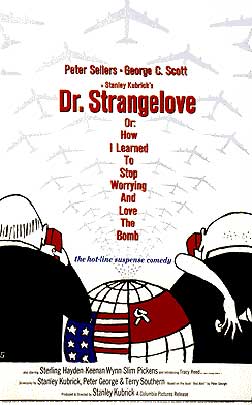
Dr. Strangelove (1967) -"Realist"
In many ways, Strangelove was the beginning of Kubrick's lurch towards authoritarian thinking. In a more "realist" approach, Strangelove sees human beings as the ultimate masters of the institutions they built, not the other way around. In the film, a crazed general gave out the signal for a plane to nuke the Soviet Union while a frantic US government tries to stop it.

The film is a clear vindication of Mutually Assured Destruction (MAD) and many of the institutions that make it possible for this catastrophe to happen, but it also tarnishes the idea of institutions having fail-safe mechanisms to prevent a crazed general or sinister President etc. from unleashing Armageddon. Thus, it puts people and institutions on a mostly level playing field, with people being slightly more important.

A Clockwork Orange (1971) - Authoritarian
With Clockwork Orange comes Kubrick's full turn into a near-fascist. In the film, Alex is a criminal who, with his gang of 'Droogs', go around raping, looting and causing chaos. What's odd is that this life of crime is mostly a secret, and that at home he is a seemingly normal young adult with decent parents and a nice house and environment to grow up in. Thus, the movie conceives of someone who is "born evil" and as the film later demonstrates, must be conditioned to become a good person.

The film's saving grace is that it views the conditioning that was put onto Alex as a worse and more dehumanizing crime than the many committed by Alex. Although as the film contends, there wouldn't be a need such authoritarian measures if people behaved.    

With this film his views would be known, Kubrick would go on to say:
"Man isn't a noble savage, he's an ignoble savage. He is irrational, brutal, weak, silly, unable to be objective about anything where his own interests are involved—that about sums it up...any attempt to create social institutions on a false view of the nature of man is probably doomed to failure."
He would later add that "The idea that social restraints are all bad is based on a utopian and unrealistic vision of man." When accused of being a fascist, Kubrick rejected it but went on to say:
Rousseau's romantic fallacy that it is society which corrupts man, not man who corrupts society, places a flattering gauze between ourselves and reality. This view...is solid box office but, in the end, such a self-inflating illusion leads to despair. 
Kubrick's friend would later characterize his beleif of democracy as a "a noble failed experiment along our evolutionary way, brought low by base instincts, money and self-interest and stupidity... He thought the best system might be under a benign despot, though he had little belief that such a man could be found."

How did Kubrick end up from promoting Rousseau's ideals to openly attacking them? I don't know but I know his other movies are more mixed.

Full Metal Jacket (1987) - Libertarian?
The big surprise came with one of Kubrick's last works, Full Metal Jacket. Despite fears that "[t]he political left will call Kubrick a fascist," it's now considered a classic anti-war film although Kubrick said that wasn't the intention. In the film various young soldiers are enlisted into the marines and go through a brutal process of training and hazing, one of soldiers eventually going crazy and committing a murder-suicide. It then picks up in urban Vietnam through the Tet-offensive and afterwards.   


In many ways, the film mirrors Paths of Glory including the Rousseauian themes of people being corrupted by society (unlike Kubrick's earlier quotes). In fact, the idea of people having to be indoctrinated in order to fight in the war, and the obvious negative portrayal of this process, is in many ways akin to what Kubrick derides. 

Ultimately, Kubrick went on a huge journey from Libertarian to Authoritarian and possibly back.

Thursday, June 30, 2011

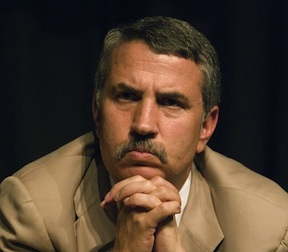
I Really Fucking Hate Thomas Friedman

Winner of 57 Pulitzer Prizes,
Philosopher Tom Friedman

Honestly of all the pundits the one I can't stand most is Thomas Friedman. There are actually quite a few reasons not to like him, some can be summerized here by Lionel Beehner:
"Not because he went from globalisation bible-thumper to born-again environmentalist overnight — columnists are chameleons, cheerleading for whatever cause is hip that day. Not because his columns involve lazy journalism (ie quoting cab drivers), sloppy metaphors (pouring water out of broken vases and such), and a scary reliance on Johns Hopkins’ Michael Mandelbaum and an overused quip about how nobody ever washed a rental car … [but rather, because] he is given tremendous access to the world’s business leaders yet he is so utterly pathetic at questioning what they are up to." 

And that's accurate but it's not so much that and it's not his political views. It's how obnoxiously generic and unoriginal his views are and yet he considers himself (and is considered) an intellectual messiah.

Thomas Friedman is the epitome of conventional wisdom, a Frankenstein of every generic opinion put together and then revered as wisdom with his cartoonish three-time Pulitzer Prize victory.

In fact, lets break down how generic his views are:

Globalization 
Friedman loves Globalization a whole lot, it's this mind altering, breath taking thing that's completely changed the world in every way imaginable. With the breakthrough of the internet and cell phones, the world is at a completely level playing field ("the world is flat") and countries in massive poverty can perform just as well as the U.S. because of iPhones and Twitter. He literally wrote a book on this, that through the magic of comparative advantage and the internet, a country like Sierra Leone is at a level playing field with the U.S. 
Oh also we need to outsource jobs and get rid of dem unions because we're globalized now what-with the internet and all. 


But really, skip listen to 0:15:39 where he compares himself to Christopher Columbus over and over again:


Terrorism   

We need to get real tough on terrorism and 9/11 happened because the Middle East is poor so all those Arabs are irrationally taking their anger out on the US because their a bunch of crazy people. Also in the 90s there was a "terrorism bubble" and we needed to pop it by invading a random Arab country (Iraq).  


Iraq War
"[T]his war is the most important liberal, revolutionary U.S. democracy-building project since the Marshall Plan."

"[It is] one of the noblest things this country has ever attempted abroad."

"I think there were four reasons for this war, and I identified with three of them: There was the stated reason, the moral reason, the right reason, and the real reason."
These are actual, real quotes. The best part is, of course in a completely unconventional twist of events, Friedman now wants to leave Iraq because it's cost is too high. Someone viciously supporting the war and then thinking it's too costly? Woah. 

Climate Change 

He thinks we really need to start investing green technology and have a market-based solution to climate change and shocker, get ready for this, we need to break the addiction to foreign oil as well. I think this man deserves a fourth Pulitzer.

Sunday, June 26, 2011

Popping The Myth of The "College Bubble": College Is Being Privatized, Not Inflated

So just about everyone has gotten this wrong, speculating that there's a "bubble" related to college which of course is caused by big government evil socialism. It's been hyped by right-wing libertarian groups like the National Inflation Association and even by supposed Serious People like Freakonomics co-author Stephen J. Dubner (although in his defense he isn't an economist but writes with an economist). 

The theory goes something like this:
  • Government has increased subsidies to pay for student loans 
  • There is a price distortion since the money is guaranteed to colleges
  • Colleges spend more and then increase the price of tuition
  • Repeat
At first glance the theory doesn't even make economic sense, subsidies lower prices, the obvious example being corn subsidies and the record low prices of corn in the United States.

The bigger problem is it assumes colleges inherently get paid through tuition which is only a very recent phenomenon. In fact for the first time ever public schools get more money through tuition than state funding.

So what's the actual problem?

Well put simply the burden of college cost is being shifted away from government funding to the students, or even simpler, colleges are being privatized. So yes, it's true that government is subsidizing tution more then ever leaving students with debt, but that wouldn't even exist if colleges weren't being privatized.


A great study (pdf.) that looked at this was done by the Delta Cost Project. As the study points there is a "pattern of cost shifting to student tuition revenues in times of economic downturn" which explains the increase in tuition and decrease in state funding. It's also worth noting that the operational cost of college, outside of private colleges, have not significantly increased, or at least not to the extend tuition has.

Put simply, schools are being privatized and students and parents are feeling the pain.