Rick Perry has been making motions to run for president for a long time now, probably because he will, and probably because he's literally the only hope the GOP has.
With the constant flow of controversy following Bachmann, Romneny, et al. Perry has everything the GOP wants in a nice package, he's well liked by his own party, has a decent personality, is adequately right-wing, extremely religious (read: Christian) but more importantly, Rick Perry can handle himself in the more "liberal media".
Notice this interview with Jon Stewart where Rick Perry defends "flexible permits" a method of avoiding regulations in the Clean Air Act, along with low corporate taxes, lax regulations, lawsuit caps and a union busting public education which attracted numerous companies (or "job creation") in a literal race to the bottom (the bottom being Texas).
Stewart, while pointing out that Perry's argument is the same for outsourcing to India (low taxes, cheap labor etc.) didn't even notice how all the things he mentioned are actually awful and was caught off guard with "Would you rather live in Texas or India?" making Stewart trip up and forget his point.
That's the magic of Rick Perry, he can make terrible right-wing policies seem sensible and jokingly cast aside criticism without looking like an asshole (even while he's supposed to get grilled by liberals). He is what the Republican party disparately needs, the only candidate that can attract both the base and a fair bit of the general electorate.
Tuesday, July 19, 2011

Friday, July 15, 2011
Shocker: Slavery is a Conservative Idea
What with the recent controversy over Michelle Bachmann signing the the anti-marriage equality pledge that talked about slavery, I think it's worth pointing out that the idea of preserving slavery is inherently conservative.
Now I'm not saying conservatives want to reinstate slavery but it's a basic axiom that being conservative means you want to "conserve" something, and the more conservative someone is the more likely they conserve archaic institutions like segregation and slavery.
Recently I got into an argument about this and found a New York Times editorial from 1860 which actually lays out this argument and decries how conservatives tried to defend slavery:
This editorial attacks the notion that slavery is "'the normal condition of society'" and thus should be preserved by conservatives. It's also striking to see the red-baiting that existed in the 1800s with "agitation".
My guess is conservatives know this full well and have been drilling obscure counter arguments into peoples heads like "liberals want to increase welfare and make people slaves to government," which not only isn't true but ignores how it was literally a "conservative" notion to want to keep slavery.
The other tactic is to ignore how Republicans were the liberal party in 1860 while Democrats were the conservatives and just drill "Republicans ended slavery" into people heads.
Oh and lets not forget this gem:

You know, Martin Luther King Jr., the guy who was a self-described "democratic socialist" who said "something is wrong with capitalism" and that "there must be a better distribution of wealth, and maybe America must move toward a democratic socialism."
Brilliant.
Now I'm not saying conservatives want to reinstate slavery but it's a basic axiom that being conservative means you want to "conserve" something, and the more conservative someone is the more likely they conserve archaic institutions like segregation and slavery.
Recently I got into an argument about this and found a New York Times editorial from 1860 which actually lays out this argument and decries how conservatives tried to defend slavery:
It is a curious phenomenon of our own day and nation that all opinions favorable to Slavery should be regarded as "conservative" and "practical," while those opposed to it should be stigmatized as the "utopian" and "theoretical" excesses of a "false philanthropy," and their expression denounced by the application to it of that dread political ban-word, "agitation." The advocates of Slavery seem to be aiming to combine in defence of their cause all the calm and solid dignity of recognized opinions with the fierce impetuosity of a new-found propaganda.- New York Times editorial, 1860
This editorial attacks the notion that slavery is "'the normal condition of society'" and thus should be preserved by conservatives. It's also striking to see the red-baiting that existed in the 1800s with "agitation".
My guess is conservatives know this full well and have been drilling obscure counter arguments into peoples heads like "liberals want to increase welfare and make people slaves to government," which not only isn't true but ignores how it was literally a "conservative" notion to want to keep slavery.
The other tactic is to ignore how Republicans were the liberal party in 1860 while Democrats were the conservatives and just drill "Republicans ended slavery" into people heads.
Oh and lets not forget this gem:

You know, Martin Luther King Jr., the guy who was a self-described "democratic socialist" who said "something is wrong with capitalism" and that "there must be a better distribution of wealth, and maybe America must move toward a democratic socialism."
Brilliant.
Sunday, July 10, 2011
A Useless Study Into Libertarian Morality
So through the magic of googling "Libertarian morality" I came across a study which observes what are said to be the "moral foundations" of humanity and looks at how conservatives and liberals-and now libertarians- identify with these foundations.
The problem is when you actually break it down, it's a poll which looks at random attributes and how conservatives, liberals etc. identify with them. How do we know that these arbitrary traits are in fact the "moral foundations" of society? I don't know but apparently the guy who made the test does.
Jonathan Haidt, the maker of the test expains his theory in this Ted talk:
Actually the real purpose of the test was to include libertarians and to show they have some sort of coherent morality and aren't just "amoral calculating rationalists" as Reason magazine puts it. So how did they prove it? Well the study found that libertarians scored low on all the traits that make up the "moral foundations" of society which of course proves...well actually it doesn't prove anything, in fact, it might just prove that libertarians don't have any moral foundation.
So to remedy this problem the researchers realized there was an awful "liberal bias" in the test by not including Liberty as one of the foundations because...it's liberal to hate liberty? And apparently these "moral foundations" are so malleable that suddenly the Five Moral Foundations™ became six?
Well anyways, libertarians scored highest on liberty showing they really love freedom and that tweaking arbitrary traits in a personality test can prove anything.
The problem is when you actually break it down, it's a poll which looks at random attributes and how conservatives, liberals etc. identify with them. How do we know that these arbitrary traits are in fact the "moral foundations" of society? I don't know but apparently the guy who made the test does.
Jonathan Haidt, the maker of the test expains his theory in this Ted talk:
Actually the real purpose of the test was to include libertarians and to show they have some sort of coherent morality and aren't just "amoral calculating rationalists" as Reason magazine puts it. So how did they prove it? Well the study found that libertarians scored low on all the traits that make up the "moral foundations" of society which of course proves...well actually it doesn't prove anything, in fact, it might just prove that libertarians don't have any moral foundation.
So to remedy this problem the researchers realized there was an awful "liberal bias" in the test by not including Liberty as one of the foundations because...it's liberal to hate liberty? And apparently these "moral foundations" are so malleable that suddenly the Five Moral Foundations™ became six?
Well anyways, libertarians scored highest on liberty showing they really love freedom and that tweaking arbitrary traits in a personality test can prove anything.
Saturday, July 9, 2011
Man Is An Ignoble Savage: The Moral Journey of Stanley Kubrick
I thought this would be fun, to compare my theory of libertarian and authoritarian morality with the moral development of the famed (and one of my favorite) film directors, Stanley Kubrick.
In his films, Kubrick went from a from having a Rousseauistic view of the innately good human being corrupted by society (the Libertarian morality) to openly attacking Rousseau and taking on a more pessimistic which some have likened to "fascist" (the Authoritarian morality)
Paths of Glory (1957) - Libertarian
 This is one of the clearest examples of Kubrick seeing the innately good human being corrupted by society. In film, a group of World War I fighters are forced to go on a suicide mission so a general can get one more star. It's probably one of the best vindications of war there is, but above all, it portrays the soldiers as a good people who are cogs of an unjust war.
In fact, it even went on to mock the central tenets of Authoritarian morality, the idea that people are evil and need to be disciplined to become good:
 In many ways, Strangelove was the beginning of Kubrick's lurch towards authoritarian thinking. In a more "realist" approach, Strangelove sees human beings as the ultimate masters of the institutions they built, not the other way around. In the film, a crazed general gave out the signal for a plane to nuke the Soviet Union while a frantic US government tries to stop it.
The film is a clear vindication of Mutually Assured Destruction (MAD) and many of the institutions that make it possible for this catastrophe to happen, but it also tarnishes the idea of institutions having fail-safe mechanisms to prevent a crazed general or sinister President etc. from unleashing Armageddon. Thus, it puts people and institutions on a mostly level playing field, with people being slightly more important.
A Clockwork Orange (1971) - Authoritarian
 With Clockwork Orange comes Kubrick's full turn into a near-fascist. In the film, Alex is a criminal who, with his gang of 'Droogs', go around raping, looting and causing chaos. What's odd is that this life of crime is mostly a secret, and that at home he is a seemingly normal young adult with decent parents and a nice house and environment to grow up in. Thus, the movie conceives of someone who is "born evil" and as the film later demonstrates, must be conditioned to become a good person.
The film's saving grace is that it views the conditioning that was put onto Alex as a worse and more dehumanizing crime than the many committed by Alex. Although as the film contends, there wouldn't be a need such authoritarian measures if people behaved.
With this film his views would be known, Kubrick would go on to say:
How did Kubrick end up from promoting Rousseau's ideals to openly attacking them? I don't know but I know his other movies are more mixed.
Full Metal Jacket (1987) - Libertarian?
 The big surprise came with one of Kubrick's last works, Full Metal Jacket. Despite fears that "[t]he political left will call Kubrick a fascist," it's now considered a classic anti-war film although Kubrick said that wasn't the intention. In the film various young soldiers are enlisted into the marines and go through a brutal process of training and hazing, one of soldiers eventually going crazy and committing a murder-suicide. It then picks up in urban Vietnam through the Tet-offensive and afterwards.
In many ways, the film mirrors Paths of Glory including the Rousseauian themes of people being corrupted by society (unlike Kubrick's earlier quotes). In fact, the idea of people having to be indoctrinated in order to fight in the war, and the obvious negative portrayal of this process, is in many ways akin to what Kubrick derides.
Ultimately, Kubrick went on a huge journey from Libertarian to Authoritarian and possibly back.
In his films, Kubrick went from a from having a Rousseauistic view of the innately good human being corrupted by society (the Libertarian morality) to openly attacking Rousseau and taking on a more pessimistic which some have likened to "fascist" (the Authoritarian morality)
Paths of Glory (1957) - Libertarian

In fact, it even went on to mock the central tenets of Authoritarian morality, the idea that people are evil and need to be disciplined to become good:
Dr. Strangelove (1967) -"Realist""You see colonel, troops are like children, and just as a child wants his father to be firm, troops crave discipline, and one way to ensure discipline is to shoot a man now and again." "Do you sincerey believe the things you've just said?"
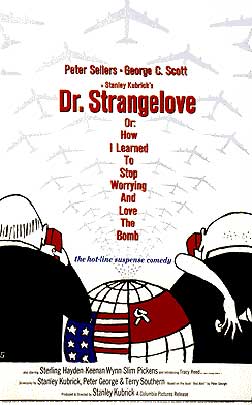
The film is a clear vindication of Mutually Assured Destruction (MAD) and many of the institutions that make it possible for this catastrophe to happen, but it also tarnishes the idea of institutions having fail-safe mechanisms to prevent a crazed general or sinister President etc. from unleashing Armageddon. Thus, it puts people and institutions on a mostly level playing field, with people being slightly more important.
A Clockwork Orange (1971) - Authoritarian

The film's saving grace is that it views the conditioning that was put onto Alex as a worse and more dehumanizing crime than the many committed by Alex. Although as the film contends, there wouldn't be a need such authoritarian measures if people behaved.
With this film his views would be known, Kubrick would go on to say:
"Man isn't a noble savage, he's an ignoble savage. He is irrational, brutal, weak, silly, unable to be objective about anything where his own interests are involved—that about sums it up...any attempt to create social institutions on a false view of the nature of man is probably doomed to failure."He would later add that "The idea that social restraints are all bad is based on a utopian and unrealistic vision of man." When accused of being a fascist, Kubrick rejected it but went on to say:
Rousseau's romantic fallacy that it is society which corrupts man, not man who corrupts society, places a flattering gauze between ourselves and reality. This view...is solid box office but, in the end, such a self-inflating illusion leads to despair.Kubrick's friend would later characterize his beleif of democracy as a "a noble failed experiment along our evolutionary way, brought low by base instincts, money and self-interest and stupidity... He thought the best system might be under a benign despot, though he had little belief that such a man could be found."
How did Kubrick end up from promoting Rousseau's ideals to openly attacking them? I don't know but I know his other movies are more mixed.
Full Metal Jacket (1987) - Libertarian?

In many ways, the film mirrors Paths of Glory including the Rousseauian themes of people being corrupted by society (unlike Kubrick's earlier quotes). In fact, the idea of people having to be indoctrinated in order to fight in the war, and the obvious negative portrayal of this process, is in many ways akin to what Kubrick derides.
Ultimately, Kubrick went on a huge journey from Libertarian to Authoritarian and possibly back.
Thursday, June 30, 2011
I Really Fucking Hate Thomas Friedman
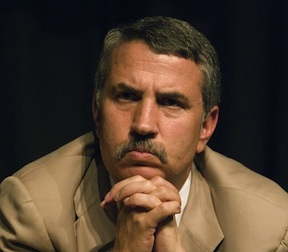 | |
| Winner of 57 Pulitzer Prizes, Philosopher Tom Friedman |
Honestly of all the pundits the one I can't stand most is Thomas Friedman. There are actually quite a few reasons not to like him, some can be summerized here by Lionel Beehner:
"Not because he went from globalisation bible-thumper to born-again environmentalist overnight — columnists are chameleons, cheerleading for whatever cause is hip that day. Not because his columns involve lazy journalism (ie quoting cab drivers), sloppy metaphors (pouring water out of broken vases and such), and a scary reliance on Johns Hopkins’ Michael Mandelbaum and an overused quip about how nobody ever washed a rental car … [but rather, because] he is given tremendous access to the world’s business leaders yet he is so utterly pathetic at questioning what they are up to."
And that's accurate but it's not so much that and it's not his political views. It's how obnoxiously generic and unoriginal his views are and yet he considers himself (and is considered) an intellectual messiah.
Thomas Friedman is the epitome of conventional wisdom, a Frankenstein of every generic opinion put together and then revered as wisdom with his cartoonish three-time Pulitzer Prize victory.
In fact, lets break down how generic his views are:
Globalization
Friedman loves Globalization™ a whole lot, it's this mind altering, breath taking thing that's completely changed the world in every way imaginable. With the breakthrough of the internet and cell phones, the world is at a completely level playing field ("the world is flat") and countries in massive poverty can perform just as well as the U.S. because of iPhones and Twitter. He literally wrote a book on this, that through the magic of comparative advantage and the internet, a country like Sierra Leone is at a level playing field with the U.S.
Oh also we need to outsource jobs and get rid of dem unions because we're globalized now what-with the internet and all.
But really, skip listen to 0:15:39 where he compares himself to Christopher Columbus over and over again:
Oh also we need to outsource jobs and get rid of dem unions because we're globalized now what-with the internet and all.
But really, skip listen to 0:15:39 where he compares himself to Christopher Columbus over and over again:
Terrorism
We need to get real tough on terrorism and 9/11 happened because the Middle East is poor so all those Arabs are irrationally taking their anger out on the US because their a bunch of crazy people. Also in the 90s there was a "terrorism bubble" and we needed to pop it by invading a random Arab country (Iraq).
Iraq War
"[T]his war is the most important liberal, revolutionary U.S. democracy-building project since the Marshall Plan."
"[It is] one of the noblest things this country has ever attempted abroad."
"I think there were four reasons for this war, and I identified with three of them: There was the stated reason, the moral reason, the right reason, and the real reason."
These are actual, real quotes. The best part is, of course in a completely unconventional twist of events, Friedman now wants to leave Iraq because it's cost is too high. Someone viciously supporting the war and then thinking it's too costly? Woah.
Climate Change
He thinks we really need to start investing green technology and have a market-based solution to climate change and shocker, get ready for this, we need to break the addiction to foreign oil as well. I think this man deserves a fourth Pulitzer.
Sunday, June 26, 2011
Popping The Myth of The "College Bubble": College Is Being Privatized, Not Inflated
So just about everyone has gotten this wrong, speculating that there's a "bubble" related to college which of course is caused by big government evil socialism. It's been hyped by right-wing libertarian groups like the National Inflation Association and even by supposed Serious People like Freakonomics co-author Stephen J. Dubner (although in his defense he isn't an economist but writes with an economist).
The theory goes something like this:
The bigger problem is it assumes colleges inherently get paid through tuition which is only a very recent phenomenon. In fact for the first time ever public schools get more money through tuition than state funding.
So what's the actual problem?
Well put simply the burden of college cost is being shifted away from government funding to the students, or even simpler, colleges are being privatized. So yes, it's true that government is subsidizing tution more then ever leaving students with debt, but that wouldn't even exist if colleges weren't being privatized.

A great study (pdf.) that looked at this was done by the Delta Cost Project. As the study points there is a "pattern of cost shifting to student tuition revenues in times of economic downturn" which explains the increase in tuition and decrease in state funding. It's also worth noting that the operational cost of college, outside of private colleges, have not significantly increased, or at least not to the extend tuition has.
Put simply, schools are being privatized and students and parents are feeling the pain.
The theory goes something like this:
- Government has increased subsidies to pay for student loans
- There is a price distortion since the money is guaranteed to colleges
- Colleges spend more and then increase the price of tuition
- Repeat
The bigger problem is it assumes colleges inherently get paid through tuition which is only a very recent phenomenon. In fact for the first time ever public schools get more money through tuition than state funding.
So what's the actual problem?
Well put simply the burden of college cost is being shifted away from government funding to the students, or even simpler, colleges are being privatized. So yes, it's true that government is subsidizing tution more then ever leaving students with debt, but that wouldn't even exist if colleges weren't being privatized.

A great study (pdf.) that looked at this was done by the Delta Cost Project. As the study points there is a "pattern of cost shifting to student tuition revenues in times of economic downturn" which explains the increase in tuition and decrease in state funding. It's also worth noting that the operational cost of college, outside of private colleges, have not significantly increased, or at least not to the extend tuition has.
Put simply, schools are being privatized and students and parents are feeling the pain.
Wednesday, June 22, 2011
Research Shows Babies Have Inherent Morality
 | ||
| This guy studied the infants... |
I've noticed a series of studies suggesting that infants already have an inherent sense of morality, which corresponds to my
Numerous studies have shown that babies as early as 5-months already have an inherent morality understanding the basic tenets of right and wrong. One of the most striking studies has to do with a morality play between a toy trying to climb a hill, and a "hero" toy who helps him up and a "villain" toy who knocks him down. The babies were then asked which toy they wanted to play with the "good" toy or "bad" toy.
According to Yale professor Paul Bloom,
In the end, we found that 6- and 10-month-old infants overwhelmingly preferred the helpful individual to the hindering individual. This wasn’t a subtle statistical trend; just about all the babies reached for the good guy.This of course suggests that babies as young as 6 months old already have a conception of morality and that this is possibly in-born like language.
It has other implications like that the weight of the evidence is towards Libertarian morality since humans are inherently moral.
Subscribe to:
Posts (Atom)